The kelp forest in the northern Salish Sea was gone before anyone knew how much had been lost. Then Brian Timmer opened a box of 1972 photographs. The photos were part of roughly 14 boxes of field notes, reports and aerial images left behind by the late researcher Alan Austin in the University of Victoria archives. They had been taken to map red algae but also captured another story: a coastline dark with bull kelp near Comox, Denman Island and Cape Lazo.
In some places, kelp stretched more than a kilometre offshore and ran for kilometres along the coast. Timmer said the photos matched stories from people who remember fishing above dense kelp beds as children, including one account of Cape Lazo kelp so thick that if someone fell from a boat, “you could basically walk back.”
The photos helped Timmer and his colleagues show something recent records had missed: climate change was reshaping kelp forests around Vancouver Island decades earlier than scientists understood. In a new UVic study, based on 1972 photos, old maps, scuba surveys and more, researchers found more than 550 hectares of bull kelp once floated near Comox and Denman Island. Most disappeared between 1972 and 1984 and none remain today.
“What we previously thought of as a baseline was already post-collapse,” said Timmer, a National Geographic Explorer, UVic PhD student and lead author of the study.Bull kelp is a foundation species, creating underwater forest habitat for herring, salmon, rockfish, invertebrates and the coastal food webs people depend on. Much attention on kelp loss has focused on the marine heat wave known as “the Blob,” which hit the northeast Pacific about a decade ago and became “the final nail in the coffin” for some kelp forests, Timmer said. But the old photos show the decline began much earlier.
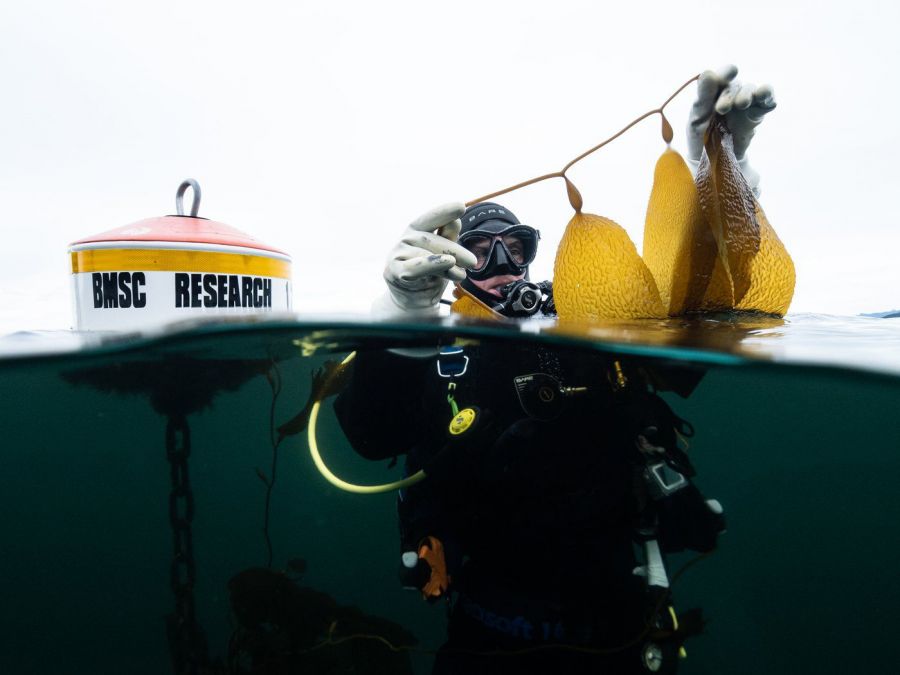
Researchers reconstructed a 1972 baseline from old maps, photos and scuba surveys, then repeated the work at the same sites in 2023 to chart 50 years of change in bull kelp and nearby seaweed communities. They found the region once held more than 10 times as much surface kelp as recent baselines suggested.
The new information can help inform decisions about where kelp can recover, where restoration may be needed and how much carbon storage has already been lost, said study co-author Luba Reshitnyk, a geospatial research scientist at Hakai Institute. Modern satellites can map kelp widely, but old data show how much “baseline” was already missing.
Temperature records dating back to 1915 showed the northern Salish Sea was already substantially warmer by the late 1970s than in the early 1900s and it has kept warming. But Timmer said similar losses could be missed along BC’s 25,000-kilometre coastline, where kelp can thrive in cold waters but disappear nearby in warmer pockets or urchin barrens.
On the Central and North Coast, kelp loss is highly localized, Timmer said. In some places, urchins have stripped the seafloor. Kelp is more stable in other areas where sea otters have returned and are keeping urchins in check. Around Haida Gwaii, previous research with the Haida Nation found some kelp forests remained stable while others declined sharply.
Governments and coastal communities must identify and protect cooler places where kelp still has a chance, Timmer said. That will take more than “just drawing lines on a map.” First Nations Guardians need money and tools to monitor, manage and restore kelp. Currently, the federal rules still manage urchins as a commercial harvest species, even where reducing them may be necessary for kelp recovery.
Heiltsuk Guardians monitor nearly two dozen giant kelp beds each summer with drones, kayaks and temperature and salinity loggers, said Diana Chan, natural resource manager for the Heiltsuk Integrated Resource Management Department. Some work is supported through the Marine Plan Partnership — a collaboration between 17 First Nations and the BC government — but funding remains limited. Chan hopes BC’s coastal marine strategy and the new protected area on the Central Coast will bring more support.
If older data reveal that BC once had far more kelp than recent surveys suggested, today’s recovery goals may be too modest, said Patrick Martone, a UBC botany professor and phycologist.
“How do we decide the degree of restoration?” he said. “Is an ecosystem ever really restored?”
Across the border in Washington state, similar historical digging has revealed a comparable collapse. Hilary Hayford, habitat research director at Puget Sound Restoration Fund, said researchers used records dating back to the late 1800s and found that in the most inland parts of Puget Sound, some bull kelp beds had declined by as much as 96 per cent, with much of the loss likely occurring between 1978 and 2013. Since 2017, kelp has continued to die in southern Puget Sound near Seattle, with some sites recently losing bull kelp altogether.
Hayford said the UVic study is useful because it looks below the floating kelp that planes and satellites can see. Timmer’s team showed seafloor algae communities that feed and shelter fish and invertebrates are changing too, a major blind spot in Washington because those habitats require divers or cameras to survey.
Heiltsuk hereditary Chief Frank Brown said the findings match his own memories and ancestral stories of a coast once thick with kelp. His father fished herring roe on the outer coast, around Cape Mark and Cape Swain, where herring spawned on kelp. Older accounts describe people harvesting marine foods far offshore and pulling canoes onto “islands of kelp.”
That abundance supported herring, salmon, bottom fish and Heiltsuk food systems and later made Bella Bella one of the world’s major suppliers of roe on kelp to Japan. Since then, both kelp and herring have gone through a “radical decline,” with many roe-on-kelp fisheries from Southeast Alaska to California now diminished or gone.
“What’s happening in the Salish Sea, in my view, is like a microcosm of what’s happening in the ocean,” Brown said. “You look at it and it still looks beautiful, but it’s not producing the way it used to.”