The pilot of a helicopter that went out of control at Smithers Airport three years ago and killed one person was distracted by his smartphone and abbreviated sections of the air operator’s checklist to expedite maintenance ground-run operations, according to a report released May 27.
“In doing so, important steps in the checklist were not completed, leaving the right anti-torque pedal in a fully forward position, which went undetected for the third maintenance ground-run operation,” said the Transportation Safety Board (TSB) investigation into the May 6, 2023, crash.
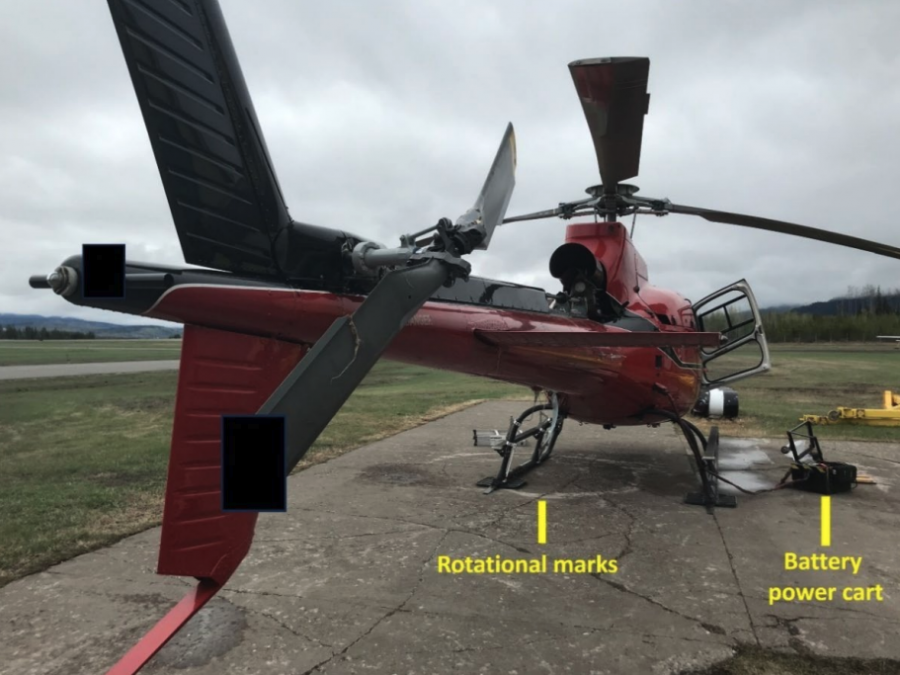
A Mustang Helicopters Inc. Airbus Helicopters AS 350 B3 was undergoing maintenance ground-run operations with a pilot on board. Two maintenance staff members were standing on the ground near the left cargo door.
The report said the pilot told maintenance staff he was listening to his smartphone with a Bluetooth earbud in his left ear.
“He was monitoring the score of a live sporting event while sitting in the pilot’s seat. It could not be determined whether the cellphone was being interacted with or viewed by the pilot immediately before the occurrence,” the report said. “Mustang had not developed procedures or policies regarding the use of personal electronic devices on the flight deck, nor were they required to.”
Because flight was not intended, the pilot did not secure his safety belt as required in the pre-start section of the Mustang checklist.
During the third operation, the pilot increased engine power from idle to flight idle. At 9:10 a.m., when it reached flight idle, the helicopter suddenly rotated to the right. The pilot moved the control to idle, turned off the fuel and applied the rotor brake.
The helicopter rotated 540 degrees and the tail rotor struck both maintenance staff members multiple times before coming to rest. The worker who survived suffered serious injuries.
“The pilot was uninjured. The helicopter received minor damage,” the report said.
TSB investigators focused on the helicopter’s hydraulic system, maintenance ground-run operations and the expectations of the team conducting the operation.
They found that when the engine was started a third time, the right anti-torque pedal was fully forward and the pilot’s feet were either lightly resting on the bottom of the pedals or not on them at all. When engine power increased, a significant yaw force was exerted on the helicopter.
“Given the position of the pilot’s feet, the pilot’s response to the yaw force was insufficient to prevent the helicopter from beginning to rotate quickly to the right,” the report said.
Since the crash, the TSB said Mustang Helicopters has changed its maintenance procedures so the aircraft maintenance engineer is inside the helicopter during maintenance ground-run operations.
The company purchased wireless communication systems for the pilot and engineer, introduced a new anti-distraction policy, reviewed and revised internal hazard assessments, and created a new standard operating procedure for ground runs and flight checks.